Thursday, 31 January 2013

Fetzer Awards to NGO`s Furthering Love and Forgiveness

Friends, in the last blog I mentioned exiting days ahead for the Journey of Hope.

One of the most exciting things about the Journey of Hope for me began when I came across an article called:

Fetzer Awards to NGOs Furthering Love, Forgiveness

Anybody that knows me or the Journey knows that would get my attention. The article can be found at: http://www.fetzer.org/our-work/projects/fetzer-awards-ngos-furthering-love-forgiveness and I have copied it here.


The Fetzer Institute is creating a tangible incentive and recognition for non-governmental organizations whose work furthers love and forgiveness--a pair of $25,000 awards and exposure via a global, web-based competition. Asking, "What in the world are YOU doing?" the program will honor an NGO within the United States and one from elsewhere in the world.

The purpose of the activity is much broader than just identifying a pair of recipients, said Fetzer Board Chairman Rob Lehman. "There’s a whole invisible community that’s already doing the work," Lehman said, "and part of our role is to make that community visible."

Philanthropy defined means "love for humanity," so there’s certainly no shortage of worthy candidates. The event seeks nonprofits who demonstrate "the joyful giving of oneself to transform other people’s lives."

Information on the international, web-based awards is available at http://www.tellusworld.org.


The competition is part of the Fetzer Institute’s broader effort to build awareness of the power of love and forgiveness in the emerging global community. As such, organizers hope submissions will demonstrate the connection between love and action by these groups, and the fostering of forgiveness by the work itself. Entries will be displayed online in a Global Gallery of videos, photos, and other information for the perusal of web visitors and judges.

Deadline for submission is Jan. 31, 2013, with public voting open from Feb. 1 until Valentine’s Day, Feb. 14. A panel of judges from the Fetzer Institute and its NGO Advisory Council will select the winners of the $25,000 awards to be announced in March 2013. A third prize of $5,000 will go to the entry that receives the most love from the online voting process.

"I think they can help us round out our understanding of love and forgiveness in ways that we could not dream in a million years," added Fetzer CEO Lawrence E. Sullivan.

This is a project of the Fetzer Advisory Council on Non-Govermmental Organizations.


Additional External Resources & Multimedia


Tell Us World web site


Journey of Hope board member Anne Feczko wrote the application explaining the Journey philosophy of love, compassion and forgiveness for all of humanity. Emmy award winning Micki Dickoff produced an excellent 5 minute video with the concept of love, compassion and forgiveness cleverly woven throughout. http://www.tellusworld.org/entry/journey-hopefrom-violence-healing


.

I would like for the Journey of Hope win the award of $25,000 dollars and I think we have a chance, but you could help us win the third prize $5000 for the entry that receives the most love from the online voting process.

Could you share this with your network friends? $5,000 would be such a wonderful blessing.

Info on the upcoming Indiana Journey of Hope Feb 22-March 10, the 5 th World Congress in Madrid, June 12 - 15, the annual Fast and Vigil, June 29 -July 2 in front of the US Supreme Court and so much more, hopefully soon.

I would like to give a public thank you to Micki Dickoff and Probono Productions for presenting the Journey of Hope when we were at our best. We are at our best when we are talking about love, compassion and forgiveness. Micki, YOU are the Greatest, and I know that you are most loved. I hope your film is too. NESHOBA is one of Micki’s works
http://neshobafilm.com/


And friends, please help us win the most loved award.

Please share this with your friends.

Till next time,

Love and Peace,

Bill


Sunday, 27 January 2013

         January 22, 2013


Hello again,


I had a goal of doing a lot more writing for the blog this year but it has been some days since I have written.

My father, Robert C. Pelke joined his personal Lord and Saviour Jesus Christ on January 10th .

He is now a part of that great host of witnesses in Heaven above.
I offered an eulogy at his funeral. I have copied it here.

I am on an airplane headed from Alaska to South Carolina. My father is dying. He had a major stroke about 12 hours ago and is in a coma and they say he will not come out of it. He is 93 years old. I hope I get to South Carolina and see him before he dies. But it is more than likely he will be in Heaven with his creator by the time I arrive. I want to see mom and I want to see my sister. Dottie has been the perfect sister in my eyes, helping take care of mom and dad these many years. I am so grateful for everything that Dottie and her family have done for them.

I always knew that someday I would get that call, but I wasn’t ready for it. When I saw my niece Kim had called I was hoping it was about my scheduled upcoming trip to Prosperity, SC next month when I was to parent sit for mom and dad because Dottie and her daughter Kim are taking Sean, Kim’s son to Florida to look at a college he is likely to attend next year. I often expected bad news when I would see Kim’s number, esp. if it was unexpected call. Kim is the one who always passes on to me medical news about mom and dad.

The message was that dad had a stroke.

Kim’s brother Scott is a family doctor in the Columbia area. I talked to my nephew about six hours ago and he told me that it was just a matter of time.

So, I have been thinking a lot about my dad the last few hours. My dad has been good man. He loves his family and he loves his God. He will soon be in God’s presence. I will soon be saying Father, into thy hands I commend my father’s spirit

I was so looking forward to parent sitting. I have so enjoyed the visits I have taken to see my mom and dad. The added bonus is that they live with my sister Dottie and her husband Frank and all her kids and grandkids live nearby, except Andy who lives in California.

My dad loved to listen to books that were on tape. He especially loved mysteries and Parry Mason was one of his favorites. I used to just sit on the couch and listen to them with him for hours at a time.

He could not see well. He only has peripheral vision. He would tell people that he could see everything but what he was looking at. For football games he would sit in a wheel chair that sat ride to the side of the TV. He could see the different colors of uniforms and see them moving. He really loved to see the movement and hear the announcers describe the plays.

My dad was a faithful man. I don’t know for sure but would bet my dad was at church last Sunday. He was always there. I am sure that whenever his pastor saw dad wasn’t there, he knew that something was wrong. My dad has been extremely faithful to every church he has attended.

I was so proud to post on facebook back in September how my parents had celebrated their 71st wedding anniversary. I didn’t think or want it to be their last. I have had so many thoughts of my dad today it would be impossible to recall them all.

But he is a good man, and his father Oscar was a good man before him. Both men were highly respected at work, church, community and in the family. Granddad and my dad were two excellent examples that God placed in my life. I thank Him for that.

On a terrible day in 1985 my father found my grandmothers body the day after she had been brutally stabbed to death. I watched my father during the wake and the funeral. He greeted people, talked with them and prayed with them. He was the son that my granddad raised him to be. I don’t know how he was able to do it but I was never so proud watching how he carried himself during that horrible time.

I do know the last thing I said to my dad was "I love you dad." That is how I ended every phone conversation. On this occasion it was on Christmas day. He responded by saying "I love you honey".

There is so much I want to say to him. I had planned on filming conversations with my dad on my I-phone and spending hours talking about his life history. I mostly was looking forward to hearing stories from him, but there were a few things I had wanted to talk about for years and thought I would get that chance next month.

When I arrived to the hospital in Columbia my father was still alive. I was able to spend the last two and one half hours of his life with him. I am so grateful to have made it there before he died.

I did find out that my dad had attended church the Sunday before he died. In fact he attended the morning and evening services. Yes, that was my dad, a faithful at the age of 93.

On Monday night he watched the National Championship Bowl game when Alabama Crimson Tide beat his long time Purdue rivalry Notre Dame. He enjoyed the game immensely, went to sleep that night after the game and never woke up again.
Dad was greeted by the words of his Lord and Savior Jesus Christ, "Well done thou good and faithful servant:" Enter you into the joy of your Lord."


I thank God for the hundreds of prayers and best wishes that were sent my way. I felt your tremendous support and gathered strength that was needed to get through those extremely difficult days.

I will end this with full intention of writing much more soon about the Journey of Hope and what we are trying to accomplish in the near future. It is very exciting. At this moment I am very encouraged and I will be sharing with you why.

Peace, Bill


Sunday, 6 January 2013

Cruel and Unusual

Cruel and Unusual


I met Terri Steinberg in front of the US Supreme Court during the 9 th Annual Fast and Vigil against the death penalty in 2002. Terri’s 20 year old son Justin had just been sentenced to death by the state of Virginia. Terri was beside herself. She did not know what to do.She read about a group of people protesting the death penalty at the US Supreme Court and came to us looking for help.

We are doing all we can to help her, and Terri has become a valuable member of the Journey family.

Terri joined us for her first Journey of Hope tour in Ohio in 2003. She has participated in Journeys in Texas, Montana, Kentucky, Virginia and even Germany.

She has become a leading spokesperson for abolition of the death penalty. Virginians for Alternatives to the Death Penalty (VAADP) has taken on Justin’s case and is working with Terri in her efforts to save Justin’s life.

Could you imagine having a son on death row even if he were guilty? We are convinced that Justin is innocent.

Justin was convicted of murder for hire. A young man named Owen Barber admitted that he had committed the murder, but was told he could escape the death penalty if he testified that Justin hired him to commit the murder. To save his own life, Owen testified against Justin. Owen was sentenced to 33 years in prison and Justin was sentenced to death. Justin has always maintained his innocence.

Cruel and Unusual

It has been a terrifying roller coaster ride for Terri. Ups and downs and ups and downs!!! A few years back Owen Barber admitted he lied in court against Justin but they could not get a court hearing to get the new evidence introduced. These were dark days.

I was with Terri in Germany on the day she saw a full ray of sunshine that brought her out of the depths of darkness. She received a phone call from Justin’s lawyers saying Justin’s appeals would be heard in court.

The hope I saw in Terri that day was more than wonderful. It was such a high for her. She cried and laughed and shook for about a half an hour. I am glad I was there to hold her. It had been so dark but she was seeing things in a much clearer light. Ray Krone, Terri and I were doing an 18 day tour in Germany in 2008 for Susanne Cardona and the German Coalition Against the Death Penalty.

On Christmas Eve a Federal Judge ordered that Justin be released by 5:00 pm on January 3, 2013 and banned prosecutors from trying him again. Terri’s response when asked how she felt about that news, said "the best Christmas present ever".

1-3-13

On Wednesday the 2nd the Chantilly Patch headline was "Judge: Justin Wolfe to be released Thursday" When a reporter asked Terri what would she do first with Justin? She said "feed him". Go mom.

I have never met, written or talked to Justin but I am aware that he loves the Washington Redskins. One of the few joys he has had on death row is when the Redskins win. I have come to find myself cheering for the Redskins so Justin can have some joy. The Skins have had a good year.

Terri was ready to have Justin come home. At about 3:00 PM on Thursday I saw this message sent out by VAADP.

UPDATE: Justin Wolfe Expected to Be Released Thursday at 5 p.m.

Once sentenced to death row, Chantilly man may soon be freed from custody.

The U.S. District Court and the U.S. 4th Circuit Court of Appeals have denied the Commonwealth's appeals regarding Justin Wolfe.

Without intervention from the U.S. Supreme Court, Wolfe is expected to be released at 5 p.m. today By Dusty Smith Chantilly Patch 2:40 p.m. Jan. 3

What wonderful news this had to be for Terri. She always has maintained that she will not get too excited until she walks away from the prison arm in arm with Justin. She knows the system has let her down before.

Two hours to go. When I received this news I was very happy for Terri. I began to check on Google for a link on this story to copy for our facebook page. Then I saw this headline.

Justin Wolf’s release halted after appeals court intervenes.

Terri was 2 hours away from holding Justin in her arms. You can read more about it here.


http://www.wjla.com/articles/2013/01/appeals-court-intervenes-bars-release-of-wolfe-83674.html#ixzz2H46kzlfW

Cruel and Unusual

What Terri and her family are going through is cruel and unusual punishment. If any member of the US Supreme Court had a mother in the same situation the death penalty would be declared no longer legal. They would recognize that it is cruel and unusual punishment for the family. What did Terri do wrong? Does she love her son too much?

When will this barbaric act come to an end?

The eighth amendment to the constitution PROHIBITS the federal government from imposing cruel and unusual punishment. Someone should take this case to the US Supreme Court in Terri’s Steinberg’s name. To put a mother through this can only be described as cruel and unusual.

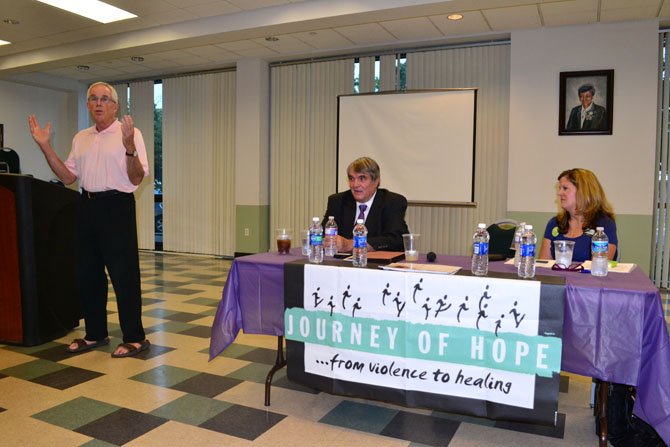
Terri has become a leading spokesperson for the Journey of Hope. She is pictured at a Journey of Hope event in Virginia last year hosted by VAADP and emceed by their ED Steve Northrup.

Today, January 5th is Terri’s birthday. She did not get the birthday gift she dreams of, Justin’s freedom. The state of Virginia is still trying to kill her son. Happy birthday Terri, we wish Justin could have celebrated it with you.


Tuesday, 1 January 2013

Happy New Year

January 1, 2013

Happy New Year,

Most of my waking moments are spent thinking about the Journey Of Hope.
This year I am making a resolution to write more about the Journey of Hope.

The Journey of Hope…from Violence to Healing will have an interesting year.
We are applying for a prize from the Fetzer Foundation that I think we have a good chance to win. There will be one twenty five thousand prize grant given to a nonprofit in the USA. If we win that the
Journey will go to places we have never been before.

In December the Journey of Hope expanded its board to eleven members.
Prior to 2012 we had 7 members. With our board election the Journey now has in place the most powerful board of directors in our history.
Ans speaking of History, 2013, is the twentieth anniversary of the Journey of Hope.
In 1993 the Journey of Hope traveled through the state for 17 days on its inaugural events.
The Journey isreturning to Indiana, February 22 to March 10. We are looking to returning to Indiana again in October with even more speakers and events.

For me, my work began in Indiana in 1985, when my grandmother was killed by high schools in Gary, Indiana.
Paula Cooper, who was 15 years old at the time of the crime, was sentenced to death becoming the youngest female on death row in this country.

On the night of November 2, 1986, my life was transformed.
I went from supporting the death penalty sentence to campaigning to have her death sentence overturned.
It was commuted in 1989 on the automatic appeal that is given to all death row sentences.
I learned the lesson of the healing power of forgiveness. It became my mission to spread the seeds of love and compassion.

I have spread the seeds of love and compassion in 15 countries and about 40 states.
2013, will be different for me, in that Paula Cooper gets out of prison on July 17. I intend to be at the gates of the prison when she gets out.
I believe in restorative justice. I want to help restore Paula to her place in society.
I have friends that want to help.It will be a very interesting year.
I have been told in places I have spoken the last few years like Germany, Belgium and Italy that they want Paula an I to come to their countries and organizations.
It will be interesting to see what Paula wants to do when she gets out.
Paula is not the same person who committed that terrible crime in 1985 and I want people to see that she has changed.
The people in Europe worked hard to save Paula`s life.
It would be so cool to be able to go with her and let the people who worded so hard, see what their work has accomplished.

The Journey of Hope has been asked to be one of the organizations on the working committe for the 5th World Congress Against the death penalty.
The conference will be in Madrid, June 18 -20. Just yesterday I was asked by a friend and Journey supporter if I needed help to get to Madrid.
When I said yes, he offered to fly me to Spain. Happy New Year!!!

2013 also brings us the 20th annual Fast and Vigil June 29 - July 2. If we get the grant I mentioned earlier I hope that all of our board members can attend a face to face board meeting in DC and do some work stategizing on how the Journey can be an even bigger impact on worldwide abolition of the death penalty.
This would be fantastic and much needed.
The grant is Fetzer Compation for NGO`s working on Love and Forgiveness, Call for Entries ( Win 25,000 dollars, open to orgs around the world)
I think we have a good chance.

We are about love and forgiveness.
We will know on February 14, who the winner is. We have a five minute video prepared for this and we are working on a 500 word synopsis. We would appreciate your prayers.
Award winning producer Micki Dickoff prepared the video and Anne Feczko, one of our new board members is working on the written part.

In January I will head to Omaha, Nebraska for an interview on a documentary called:
"There Will Be No Stay"


It looks to become an exciting year.

Bill Pelke

www.journeyofhope.org

Monday, 19 November 2012

Indiana Journey of Hope 2013

Back Home Again In Indiana


Monday, November 19, 2012 
By: Bill Pelke

“Back Home Again In Indiana”
By Ballard MacDonald and James F. Hanley, 1917
Verse One
I have always been a wand’rer
Over land and sea
Yet a moonbeam on the water
Casts a spell o’er me
A vision fair I see
Again I seem to be

Chorus
Back home again in Indiana,
And it seems that I can see
The gleaming candlelight, still shining bright,
Through the sycamores for me.
The new-mown hay sends all its fragrance
From the fields I used to roam.
When I dream about the moonlight on the Wabash,
Then I long for my Indiana home.

Verse Two
Fancy paints on mem’ry’s canvas
Scenes that we hold dear
We recall them in days after
Clearly they appear
And often times I see
A scene that’s dear to me

Dear Folks,
The Journey of Hope…from Violence to Healing will be back home again in Indiana for our 20th anniversary in 2013. The Indiana Journey of Hope in 1993 was the inaugural event in our quest for worldwide abolition of the death penalty. On February 22-March 10, 2013 we will be conducting a limited Journey of Hope with a group of speakers traveling throughout the state of Indiana and into the Chicago land area.

This Indiana Journey will be very personal for me. I was born and raised in Indiana. I retired from Bethlehem Steel in Northwest Indiana. My kids, grandkids and great grandkids all live in Indiana.

My uncle Laverne used to take me to the Indianapolis 500 time trials when I was young. Jim Nabors has opened race day festivities for many years now with his rendition of ‘Back home again in Indiana’. I appreciate his sentiments more and more each time I hear him sing it.

I moved to Anchorage, Alaska in 1999 and I love it here. I have met some of the most wonderful people in the world right here in Anchorage. Members of Alaskans Against the Death Penalty, First United Methodist Church, Alaska’s Amnesty International Program to Abolish the Death Penalty, the Alaska Innocent project, the Alaska ACLU and others have been very appreciative and supportive of the Journey of Hope. I love them all. But when I travel to Indiana I am back home again.

These Journey friends will be joining me in Indiana.

Randy Gardner is the vice-chairman of the Journey of Hope…from Violence to Healing Board of Directors. Randy’s brother Ronnie Lee Gardner was executed by firing squad in Utah about two and a half years ago. Randy will be sharing his family’s story. The Journey has provided a platform for Death Row Family Members since 1993.

Terri Steinberg will be there. Terri’s son Justin was sentenced to Death by the State of Virginia under the ‘murder for hire’ law. I am convinced that Justin is innocent. But innocence aside, I cannot understand why our society insists on inflicting this kind of pain on mothers like Terri. The Journey totally supports Terri as she campaigns for worldwide abolition of the death penalty. The state of Virginia wants to kill her son and we want him to live.

Randy Steidl will be joining the Journey of Hope for the first time. Randy was sentenced to death by the State of Illinois and was eventually able to prove his innocence. Randy is active member of Witness to Innocence and as a resident of a neighboring state, Randy said he would be happy to be part of this Indiana Journey. The Journey of Hope has enabled many exonerees to share their stories. These stories have inspired thousands upon thousands of people around the world. Juan Melendez, Shujaa Graham, Curtis McCarty, Ray Krone, Randall Dale Adams, Delbert Tibbs, Greg Wilhoit, Sunny Jacobs and many other exonerees have shared the Journey stage.

Bess Klaussen-Landis will be back home again in Indiana too. In 1969 Bess’s mother, Helen Klaussen, was murdered in Elkhart, Indiana. Bess will share the journey that she and her sisters have been on. She will talk about the private fears that this sort of unsolved crime creates. She has served as a board member of the Journey of Hope and has spoken at Journey events around the country. Bess is a school teacher in Vermont and has written and recorded two albums, Beauty So Close and Way up in Vermont. Bess says that the Journey of Hope helped her find her voice. It is a powerful voice, a voice of love.

George White is a cofounder of the Journey of Hope…from Violence to Healing and recently rejoined the Journey of Hope board of directors. George and his wife Charlene were shot in 1985 at George’s place of business in Enterprise, Alabama. George survived, Char died in his arms. In this country, do we convict people for crimes they didn’t commit? Ask George what his family thinks about that when he joins our weekend events. George is now living in northwest Indiana and works for CR England.

The Purpose of this Journey is Threefold

  1. Help support the growth of the Indiana Abolition Coalition. We will raise the awareness of IAC, help increase their data base, and to help them in their mission to build consensus to end the death penalty in Indiana through education, collaboration and activism.
  2. To raise support for a major Indiana Journey of Hope event October 4-20, 2013. We would travel the same trails we blazed so successfully in 1993. The dates would coincide with the World Coalition to Abolish the Death Penalty’s Annual World Day Against the Death Penalty October 10, 2013. The African Journey of Hope to Uganda, Rwanda and Kenya took place during World Day activities in 2010. With world-wide support we can do this major event in October and it is our goal that the limited events in February and March bring about the needed attention and support for this to happen.
  3. Seize the Day. The time is definitely right. We are starting to win. What just happened in California a few days ago was remarkable. 47% voted to end the death penalty. The percentage was much lower during the California Journey of Hope in 1995. It shows what a huge role education plays in abolishing the death penalty.
The Journey of Hope has a great board of directors. Cofounders George White and SueZann Bosler join with me to serve with Jo Berry, Esther Brown, Reece Robert, Rais Bhuiyan, Rick Halperin and Randy Gardner. These dedicated abolitionists are all making this world a better place to live. Jasmin Jenni is our webmaster and lives in Switzerland. Jasmin’s contribution and that of her predecessor Gilles Denizot has been greatly appreciated. Thanks to you both for making the Journey stories more visible with a first class web site. Your volunteer work has been very important to the Journey’s success.

George White and I had the opportunity to meet with Doris Parlette and the Indiana Abolition Coalition board of directors in Columbus, Indiana on October 13. We presented the Journey of Hope’s vision of the major event in October 2013. The death penalty has been on decline in Indiana. In the late 1980’s there were about 40 people on death row. Now there are 14. Indiana doesn’t seem to be in a hurry to kill, unlike a few states I could name. There are dedicated people in Indiana who are organizing for abolition now.

As president and cofounder of the Journey of Hope…from Violence to Healing, you can rest assured I am an abolitionist. I have served on the board of directors of the National Coalition to Abolish the Death Penalty (NCADP) since 1996, the board of Murder Victims’ Families for Human Rights (MVFHR) since 2005 and the board of Alaskans Against the Death Penalty since 1999. I am on the advisory board of the Campaign for the Fair Sentencing of Youth (CFSY), Dream One World and Project Hope to Abolish the Death Penalty (PHADP). I am a cofounder of the Abolitionist Action Committee (AAC). The Journey will once again be a sponsor as the AAC hosts the 20th Annual Fast and Vigil in front of the United States Supreme Court June 29-July 2, 2013. I have never missed a day of these events since we began in 1994. I hope to see you in DC next year.

It was the State of Indiana that sentenced Paula Cooper to die in the electric chair on July 11, 1986 for the murder of my grandmother Ruth E. Pelke. Judge James Kimbrough’s decision that day changed my life. I didn’t realize how much until November 2, 1986. On this day, in a miraculous way, I learned the lessons of love and compassion and about the healing power of forgiveness.

I was able to visit with Paula last month after meeting with the Indiana Abolition Coalition. Paula will be released from the Rockville Correction Facility on July 17, 2013 and I will be back home again in Indiana to greet her at the gates of the prison when she is released. I believe in restorative justice.

Yes, Indiana is a special place to me. It is where I grew up. It is where my grandparents, parents, aunts, uncles, cousins and many friends lived. It was in Indiana that I that I got to know my grandmother, whom we all affectionately called Nana. It was through Nana’s life and death that I learned about love and compassion, I learned about healing power of forgiveness and I learned restorative justice should be our goal.
  1. Love and Compassion for All of Humanity
  2. The Healing Power of Forgiveness
  3. Restorative Justice
The Journey of Hope…from Violence to Healing has also adopted these tools for our abolition work. The Journey of Hope needs your help to help to spread these seeds of love and compassion for all of humanity. Because of you the Journey of Hope has been sowing this seed for over 20 years. We have seen this precious seed grow, mature and bring forth fruit. Can you help us sow more seed?

We need your help

Can you make a donation?
Can you organize some events?
Can you host a fundraiser for the Journey?
Would you like to be a Journey intern?
Can you think of something you could do to help make a Journey a success?

Please call me at 877-9-24GIVE (4483) toll free USA or 907-929-5808 for international calls. You can also email me Bill@JourneyofHope.org. The Journey has no staff, we are all volunteers. We have no major funding. We need your help!

We know we will be successful but the degree of our success in Indiana and around the world is up to you.
I can’t wait to get back home again in Indiana.

Back home again in Indiana
And it seems that I can see
The gleaming candlelight still shining bright
Thro' the sycamores for me
The new mown hay sends all its fragrance
From fields I used to roam
When I dream
About the moonlight on the Wabash
Then I long for my Indiana home

Donate Now. Thank you for your support. God Bless You!!

Friday, 5 October 2012

A life and legacy


A life and legacy

Pelke's devotion to family, faith resonates decades after murder

by Sarah Tompkins


Ruth Pelke's family has fond memories of holidays in her Gary home, complete with crocheted gifts, colored cookies and "Nana salad," Pelke's macaroni salad mixed with watermelon pickles.
But in 1985 four teenage girls turned their stepgrandmother's dining room into a crime scene, leaving Pelke dead with more than 30 knife wounds piercing her 78-year-old frame.
"It went through her body, through the carpet, through the padding on the floor," said Pelke's stepdaughter, Ruth Weyhe, now 88. "There were marks in the floor."
In an infamous case that made national headlines, 15-year-old Paula Cooper, 16-year-old Karen Corder, 14-year-old Denise Thomas and 15-year-old April Beverly were arrested and charged as adults in relation to the murder.
"Christmas has never been the same, that's for sure," said Pelke's now 64-year-old grandson, Bill Pelke.
'I just loved her so, so much'

Ruth Pelke grew up and worked on a farm in Peru, Ind., doing manual labor as well as helping her neighbors with chores as the women recovered from childbirth, according to her family. She was a second or third cousin to Weyhe and Robert Pelke's mother, and they said the family would see her during trips to the countryside.
Robert, Pelke's stepson who is 92 and living in South Carolina, said he always would remember how much faith Pelke had in him. And how she once trusted him to drive a wagon full of hay as a teenager – which he accidentally flipped over after turning a corner too sharp.
"She didn't hold it against me," he said. "She treated me very good. It was just one of those things she took in stride. She was very cool. She took everything calmly."
Weyhe, who now lives in Porter County, said she recalled farm trips dating back to when she was 4 years old.
"I used to go with her out to the pasture and bring in the cows and stand there and watch her milk," Weyhe said. "I just followed her everywhere. I just loved her so, so much."
A year after her mother died from leukemia, she said her father and Pelke became an item. But before Pelke would marry Weyhe's father, Pelke said he had to first ask his children if they would be OK with it.
Weyhe said they were thrilled.
"I remember her and granddad having a wonderful relationship," said Karen, Pelke's 47-year-old granddaughter. "They would joke around and he would tease her and smooch with her. He was always very loving and she was very loving back to him."
It was Pelke's first marriage, and she never had any biological children.
"She took on a whole family," said Pelke's 51-year-old grandson, Jon. "She was the only grandmother any of us had."

The family threw her a joint 70th birthday party and "Nana's Day" in May shortly after Mother's Day, donning Pelke with a queen's robe and crown. Bill said one of the reasons for celebrating her was because she didn't stand to be honored at a Mother's Day service.
"I guess because she didn't have any kids of her own, she didn't feel like she was a mother," Bill said. "And that bothered me."

Pelke opened her arms to her nonbiological family, as well as her church family. Her relatives said she was an active member of her Baptist church and volunteered as part of a child evangelism program in her neighborhood. For about an hour sometimes five days a week, she would meet with youths and share Bible stories ranging from David and Goliath to Noah's ark.
She was known for using vibrant flannel graphs to tell those stories, her family said, sticking figures made of flannel and paper against unique flannel backgrounds propped on an easel.
"She was just a loving, caring person and she spoke positively of people," said granddaughter Dottie McKay, 67, of South Carolina. "She loved the Lord."
McKay said Pelke was killed shortly before McKay's daughter's high school graduation party, and they found the card she had prepared for her daughter after Pelke's death.
"If you had a perfect grandmother or mother, she would be the one," McKay said.

That day
Pelke had been living alone since her husband, Oscar, died in 1983, and her family members said they had been trying to get her to move as Gary's crime rate started to rise.
The day before her murder Robert had gone to visit Pelke to talk about getting the Adams Street home in Gary's Glen Park neighborhood fixed up and ready to sell. Weyhe, also a widow at the time, said she had been considering trying to buy a place with Pelke to help get her out of the area.
"She wasn't afraid to stay where she was," Robert said. "She said she'd stay there until she went to heaven."
And on May 14 when Robert went to pick up Pelke for some errands, he found her body on a blood-soaked floor with a towel over her face.
"The first thing I did was lift up the towel and I saw she was dead," Robert said. "I grabbed the telephone, and it was jerked out of the wall, and then I had to run up and down the street. I couldn't find a neighbor home or nothing."
Bill said his father flagged down a car and asked to use their phone because his mother had been killed.
"I know he had never referred to her as his mother, and that was the first time I heard him do that," Bill said.
Karen said she found out after coming home and watching it on the news, as cellphones were rare in the 1980s. Her brother, Jon, said he listened to a radio broadcast as the news broke.
"I remember hearing it on the radio and not knowing and just feeling this feeling," Jon said. "And then when I was told when I got home what had happened, you're talking about shock. It was heinous."
Karen said it was a blessing to find out who did it so soon.
"I think hearing about it and not knowing what happened, you have terrible thoughts in your mind about who did this," she said. "You don't think young girls. You think men, and what else did they do to this helpless woman?"
Bill said he remembers showing up to the house, seeing his father and another relative trying to scrub stains off the wall and carpet.
"(I) visioned her butchered on the dining room floor and it would just tear me apart," he said. "I couldn't stand to think about it.”

What's in a sentence?
Cooper was sentenced to death at age 15 for the murder of Pelke.
But through a series of events where Indiana law increased the age a child could be put to death to 16, the state Supreme Court ruled putting Cooper to death would be unconstitutional.
Her sentence was commuted to 60 years, and through credit for time served, a day off for each day of good behavior and credit for educational programming and certificates, she is scheduled to be released in 2013.
While Pelke's family members said they agree on the principals of mercy and forgiveness, they did not all have the same view of what justice is.
Bill, once a supporter of the death penalty, later became one of Cooper's biggest advocates. He said he forgave her and has seen how she's changed through their letter exchanges and visits over the past several decades.
"If she was somebody who was 30 or 40 years old, I might not have the same sentiment," Bill said about giving her a second chance because of her youth. "I figured it was up to the state of Indiana to decide when she would be eligible to get out ... so I had no problem that she would get 30 years."
Robert said that while he was a supporter of the death penalty, he was not upset that Cooper's sentence had been commuted and that she would be released in a little less than a year.
"In other words, there was nothing I could do about it," he said. "She was gone, the people were found guilty and punished according to the law. I was satisfied and that's were I left it. … If you hang onto it, it tears your life apart."
Others said they did not think the punishment fit the crime.
"At 15, you know it's murder," Weyhe said. "And (Pelke) was murdered with such force."
Jon said he would want to ask Cooper why she had to stab Pelke so many times. When told his question, Cooper said she would want to have that conversation with Jon, and that she was "very, very remorseful."
The disparity between the 60-year sentence and the less than 30 years of actual time served was frustrating for some family members, Karen said.
"You're gullible and think 60 years, she's got to be 75 when she gets out ... but that's not what they really mean," Karen said. "It's a sleight of hand in our justice system."
Randolph Stone, a clinical professor of law at the University of Chicago, said the state system does not make sentencing very clear, and that there is a movement to have more truth in sentencing where a year means a year — or at least more than six months.
"That's one of the things that needs to change about the system, is the transparency of the sentencing process," Stone said. "It's very complicated for lawyers, let alone the public."
He also said having a carrot to dangle in front of prisoners as an incentive to behave while behind bars helps wardens control the population.
For those who don't think she should be getting out next summer, Cooper said they are justified in whatever they feel, be it positive or negative.
"They are not going to understand it no matter what I say," she said from Rockville Correctional Facility. "That's just the way they feel. People are entitled to the way they feel."


Sentence breakdown

Paula Cooper was sentenced to death in 1986 for the murder of Ruth Pelke. In 1989 her death sentence was commuted to 60 years behind bars. Here is the breakdown of her sentence calculation resulting in a 2013 projected release date:
60 years minus about 29 years for good behavior with day-for-day credit = 31 years
31 years minus 4 years for time served before 1989 = 27 years
27 years minus 3 years for educational programming = 24 years served
SOURCE: Indiana Department of Corrections


A second chance at life

A second chance at life

Paula Cooper: Convicted of murder at 15, a Gary woman prepares for her 2013 release

by Sarah Tompkins


ROCKVILLE, Ind. | Paula Cooper mixed no-bake cookies, creating balls of sweet coconut and baking cocoa the size of a fist.
The 42-year-old woman was preparing meals for more than 100 prison staff at Rockville Correctional Facility -- where she has spent most of her life.
“I take great pride in what I do,” she said of cooking. “People have to trust you to eat your food. That's the most personal thing that they could do -- is taking something out your hand and believing you've done nothing to it.”
In 1985, Cooper was convicted of fatally stabbing an elderly Gary Bible school teacher 33 times with a butcher knife.
She was 15 years old.
The murder involved three other teenage co-defendants from Gary's Lew Wallace High School and left the region shaken.
Cooper was the only one sentenced to death -- a sentence eventually commuted after international attention and new state legal precedent.
Initially facing the electric chair, Cooper's sentence was commuted to life in prison.
Now, more than 25 years later, Cooper says she is a different person, tutoring inmates in the culinary arts while she is counting down the days to her 2013 release. And a second chance at life.
“Seven, eight years ago, I couldn't say I was ready to go home, and I wouldn't tell anybody that because that was a lie,” Cooper said about her rehabilitation. “My time is coming and, you know, I just hope that people give me a chance out there. That's it -- because people do change.”

The crime
It was a spring day when Cooper and three other teenagers decided to rob a house.
“We just had got really bored,” Cooper said. “We had started burglarizing people's houses, and that's basically got us to the point where we were at.”
April Beverly, whom Cooper said she met in person for the first time that day, lived behind a 78-year-old grandmother's house and suggested that house be their target.
Ruth Pelke lived alone in her Adams Street home in Gary's Glen Park neighborhood. Family members called her “Nana,” and she took interest in sharing Bible stories with children, including Beverly, in the Gary neighborhoods.
While accounts differ as to what exactly happened inside Pelke's house on May 14, 1985, Cooper describes the crime as a “robbery gone bad.”
“It was a murder,” Cooper said. “And it wasn't one that was planned or premeditated. It just happened.”
Cooper said the other burglaries were done at various vacant homes, and this one was different because, unbeknown to them, Pelke was there.
And she invited the girls into the house.
According to records, the teenagers pretended to be interested in taking part in Pelke's Bible classes. When Pelke let them in to write down the information, she was hit over the head and then stabbed dozens of times with a 12-inch knife.
“Once we got inside, it was like, 'What do we do now?'" Cooper said. “And everything just started happening ... It was a long time ago, and there are some things I can remember about it and some things I don't, but it just was never the intention, we just never had the intention of hurting anybody.”
While records place the knife in Cooper's hands, she said it was in everyone's at some point. The girls ransacked the house, stole about $10 and Pelke's car keys and drove away.
Cooper said they were “panicking, and then just one thing is leading to another, and everything is just moving really fast.”
Bill Pelke, the victim's grandson, said his son turned 15 the day his grandmother was killed.
“At first I thought, well, it was probably some 30-, 40-year-old drug addict, you know, trying to get money for a fix or something,” said Bill, now 64. “When we found out several days later that it was ninth-grade girls, it was just a real, just a real shock.”
Denise Thomas, then 14, Karen Corder, then 16, and April Beverly, then 15, later received sentences ranging from 25 to 60 years in prison. Thomas was convicted of murder, Corder pleaded guilty to murder and Beverly pleaded guilty to robbery in connection with the murder.
Beverly was pregnant and Corder a young mother at the time of the crime.
Cooper said she felt like they conspired against her to get favorable sentences, and that she, in turn, took the biggest fall.
“I think one of the misconceptions is that I was some ringleader of this big murder; that's not true,” said Cooper, who had no prior criminal record. “What I want people to know is that all four of us were guilty, and that's the bottom line. There was no innocent person in that house.”
After pleading guilty in April 1986 to murder, and murder while committing a robbery – without the benefit of a plea deal – Cooper was sentenced to death.
Indiana legislators later changed the law to make 16 the minimum age someone could be sentenced to death. But the law was written to exclude Cooper. International media attention and petitions for clemency on Cooper's behalf poured in from around the world, including from Pope John Paul II.
In 1989, the Indiana Supreme Court ruled it was unconstitutional to sentence someone younger than 16 to death, and the high court commuted Cooper's sentence to 60 years in prison. It was the second harshest sentence for murder at the time.
“This is a difficult conclusion to reach because of the gruesome nature of Cooper's acts,” wrote Supreme Court Chief Justice Randall Shepard in the court's opinion.
And with a day knocked off a state sentence for every day of good conduct, Cooper is scheduled to be released July 17, 2013.

The time
Cooper wears a maroon T-shirt over khaki-colored pants, her daily prison garb, with a yellow I.D. clipped below her left shoulder. She has short, black hair, wears white and brown eye shadow and is soft-spoken. She describes herself back in the 1980s as “horrible.”
“I'm the type of person that I don't like to be fake,” she said. “I don't like to pretend with people. I mean, I was a very troubled person years ago. I was very troubled, had some very serious issues with myself and people, period.”
According to reports and Cooper herself, she was originally from Chicago, physically abused as a child, ran away from home starting at about age 12 and had regular contact with the Juvenile Detention System.
One report describes how Cooper was beaten with an extension cord and how a family member placed Cooper and another young relative in a car and started the engine in a garage in a murder/suicide attempt.
After years of being bitter in prison and falling into the negativity that hovers over many in that environment, Cooper said she has changed.
“If I never have hope, if I never have faith, if I never believe in anything, and I'm just sitting here moping around all day long, my life is just one ball of misery,” she said. “You have to learn how to deal with your own bitterness and anger and the things that's going on inside.”
Cooper credits her growth to God's intervention and her taking advantage of Rockville's programming after transferring nine years ago to the facility about three hours south of Gary.
Cooper was previously involved for discipline issues, but is now a leader among inmates, tutoring many in culinary arts. She said she felt like she had a lot to prove to people, and she was proud to be instructing fellow inmates on how to properly prepare meals.
“There's a lot of people in there that's never cooked before," Cooper said. “Ever.”
Her first job after arriving at Rockville was for Prison Enterprise Network, known as PEN Products, a division of Indiana's Department of Correction that manufactures various products for the state prisons and has some joint ventures with private companies as well.
Cooper said the woman in charge told her she originally never had any intention of hiring her. But after Cooper explained her past and shared her present, she was hired.
“That was my first chance, and I didn't want to let her down because I felt like she was the first person I encountered here at this facility, and if I had've disappointed her, then I was never going to be able to redeem myself,” Cooper said.
Cooper said she ended up a valued employee, pressing more than twice the daily quota of metal parts used for doors and ice machines.
And while she said she's grateful to count her mother and sister among her supporters, she has found another source of strength in an unsuspecting place: Bill Pelke, the murder victim's grandson.
“He's my -- he's my biggest encouragement,” Cooper said.
Bill Pelke, who once agreed with the judge's death-penalty ruling, became one of Cooper's strongest advocates in having that sentence commuted. They have written each other almost weekly for decades, and have in-person visits when possible.
Pelke said he realized his grandmother would have wanted compassion for Paula, and that God made forgiveness in him possible.
“We're supposed to hate the sin but love the sinner,” said Bill Pelke, who wrote a book about his experience and helps victims' families through the nonprofit Journey of Hope, From Violence to Healing. “Paula has changed. She's not the same person that committed that terrible crime in 1985.”

The future
With just about a year left of her sentence, Cooper is looking forward to giving back to society and getting a job.
But she said she is worried society will not give her the opportunity because of her past.
“We should pay for our crimes and we should, you know, take our punishment,” Cooper said. “But everybody deserves a second chance.”
That ability to find work is one factor in whether inmates return to prison, according to various studies. In Indiana, about 40 percent of the prison population released in 2005 went back behind bars within three years, according to the DOC.
“I mean, I don't care if I have to sweep floors, wash dishes or flip hamburgers, I'm going to take what I can get, you know, just to get on my feet and show people that I deserve a chance. Because I've done my time,” Cooper said.
During her decades in prison, Cooper has earned her GED, received a bachelor's degree, completed an apprenticeship program in housekeeping and collected various certificates. She said she hopes it helps her find steady work, and that regardless, she wants to talk to troubled youth and help them avoid making her mistakes.
“You know, I have a real story,” she said. “And there's somebody out there, even if it's just one kid, that will listen. And I'm hoping to get them.”

---------------------------------

Timeline of events

May 14, 1985: Bible teacher Ruth Pelke is murdered.
May 15, 1985: Stepson Robert Pelke discovers her body.
May 1985: Four Lew Wallace High School students arrested for the murder of Ruth Pelke -- Karen Denise Corder, 16; Paula Cooper, 15; April Beverly, 15; and Denise Thomas, 14.
Nov. 7, 1985: Denise Thomas convicted of felony murder/murder on Dec. 4, 1985; Sentenced to 35 years in prison.
March 26, 1986: Karen Corder pleaded guilty to murder of Ruth Pelke on May 29, 1986; Corder sentenced to 60 years in prison.
April 21, 1986: Paula Cooper pleaded guilty to the stabbing murder of Ruth Pelke.
June 23, 1986: April Beverly pleaded guilty to robbery in connection with the murder of Ruth Pelke.
July 18, 1986: April Beverly sentenced to 25 years in prison.
July 11, 1986: Paula Cooper is sentenced to death.
July 13, 1989: Indiana Supreme Court finds Paula Cooper's death sentence unconstitutional and commutes her sentence to 60 years in prison.
July 17, 2013: Paula Cooper's scheduled release from prison.

---------------------------------

May 14, 1985: Bible teacher Ruth Pelke is murdered.

May 15, 1985: Stepson Robert Pelke discovers her body.

May 1985: Four Lew Wallace High School students arrested for the murder of Ruth Pelke -- Karen Denise Corder, 16; Paula Cooper, 15; April Beverly, 15; and Denise Thomas, 14.

Nov. 7, 1985: Denise Thomas convicted of felony murder/murder on Dec. 4, 1985; Sentenced to 35 years in prison.

March 26, 1986: Karen Corder pleaded guilty to murder of Ruth Pelke on May 29, 1986; Corder sentenced to 60 years in prison.

April 21, 1986: Paula Cooper pleaded guilty to the stabbing murder of Ruth Pelke.

June 23, 1986: April Beverly pleaded guilty to robbery in connection with the murder of Ruth Pelke.

July 18, 1986: April Beverly sentenced to 25 years in prison.

July 11, 1986: Paula Cooper is sentenced to death.

July 13, 1989: Indiana Supreme Court finds Paula Cooper's death sentence unconstitutional and commutes her sentence to 60 years in prison.

July 17, 2013: Paula Cooper's scheduled release from prison.